

Commentary
Michael Young
{
  "authors": [
    "Michael Young"
  ],
  "type": "commentary",
  "blog": "Diwan",
  "centerAffiliationAll": "",
  "centers": [
    "Carnegie Endowment for International Peace",
    "Malcolm H. Kerr Carnegie Middle East Center"
  ],
  "englishNewsletterAll": "",
  "nonEnglishNewsletterAll": "",
  "primaryCenter": "Malcolm H. Kerr Carnegie Middle East Center",
  "programAffiliation": "",
  "regions": [
    "Iran",
    "Israel",
    "United States"
  ]
}
Source: Getty
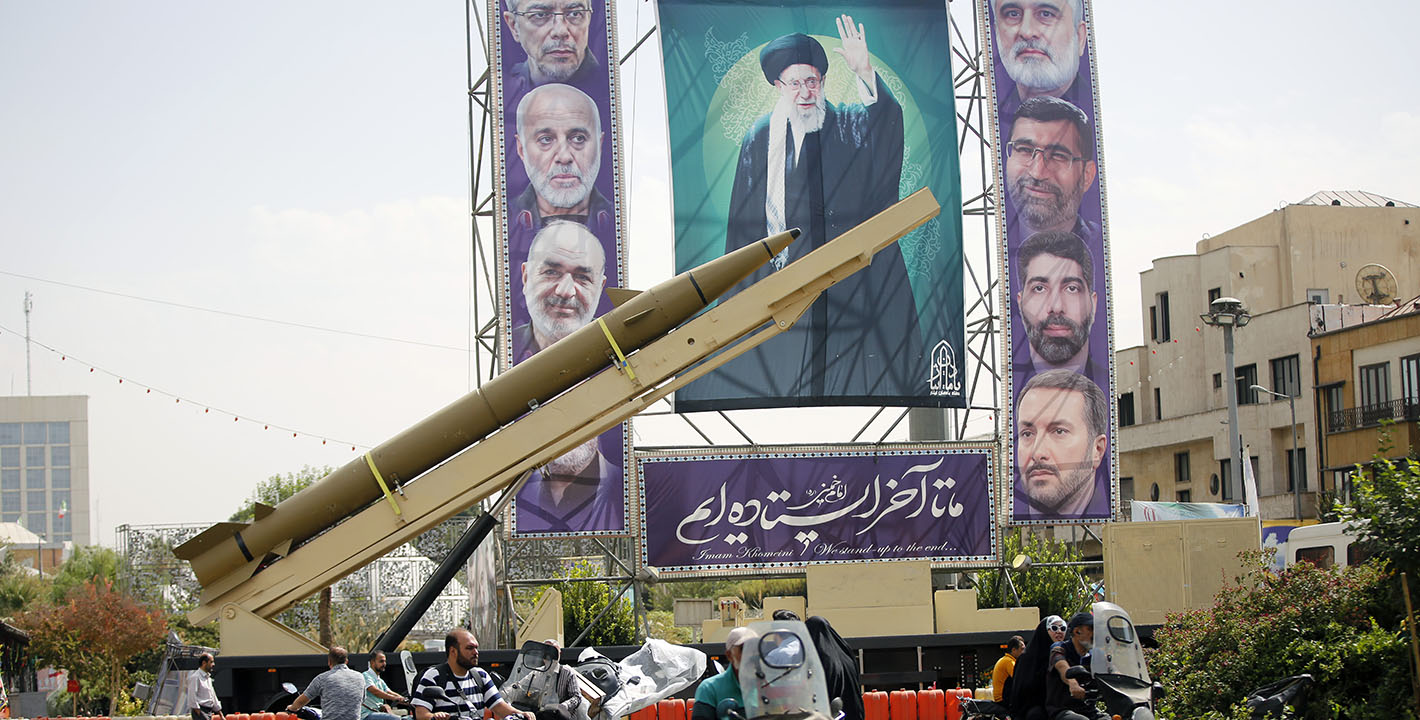
In an interview, Hamidreza Azizi discusses how Tehran has adapted in real time to the conflict with the United States and Israel.
Hamidreza Azizi is a visiting fellow at the German Institute for International and Security Affairs (SWP) in Berlin and an associate at the Clingendael Institute in The Hague. He writes the Iran Analytica Substack, and last week published a highly interesting analysis of Iran’s military strategy in the current war with the United States and Israel, titled “How Iran Rewrote Its War Strategy.” Diwan interviewed Azizi in late March to discuss his article, and more broadly where the war in the Gulf is heading, in particular the possibility of a negotiated end to the conflict.
Michael Young: You just published an article on your Substack, titled “How Iran Rewrote Its War Strategy: From Defensive Posture to Offensive Logic in a Regionalized War.” Briefly, what are your main takeaways?
Hamidreza Azizi: I make three main arguments in the article. First, I argue that Iran’s current strategy should be understood as a response to the failure of its prewar deterrence model. For years, Tehran relied on a hybrid approach: deterrence by denial, built on strategic depth through its network of regional allies and proxies, combined with deterrence by punishment, centered on the threat of massive missile retaliation. In practice, however, the system leaned heavily toward denial, while the punitive component suffered from a credibility gap. The war has exposed the limits of that model. What Iran is now doing is not simply responding militarily, but attempting to establish a new deterrence under fire. This emerging model relies more explicitly on punishment, through the actual use of missiles and drones and the targeting of critical infrastructure, in order to raise the cost of not only the current war but also any future attacks.
Second, the war has been deliberately regionalized. Iran is not treating the confrontation as a bilateral exchange with Israel or the United States, but as a multi-theatre conflict in which different fronts—Lebanon, Iraq, the Persian Gulf, and maritime chokepoints—are integrated into a single strategic space. This allows Tehran to stretch U.S. and Israeli resources, complicating their planning and creating constant uncertainty about where pressure will emerge next.
Third, this shift is tied to an acceptance of attrition as a strategy. Iran is not seeking a quick end to the war, but is instead trying to sustain pressure over time—militarily, politically, and economically—in order to alter the adversary’s cost-benefit calculation. In that sense, the objective is not battlefield victory in a conventional sense, but producing a new strategic equation in which the threshold for attacking Iran has been raised.
MY: While your focus is on a panoply of steps the Iranians have taken in this war to expand the battlefield, one thing in particular appears to have had the most impact on what happens, namely the closure of the Strait of Hormuz. Could Iranian strategy have relied entirely on that one step—by which I mean could that have been enough to place the United States on the defensive and shift the momentum of war?
HA: The short answer is no. The Strait of Hormuz has been Iran’s most effective lever in this war, but on its own it would not have sufficed to shift the overall momentum or place the United States on the defensive in a sustained way.
What Hormuz does is create immediate, systemic pressure. By disrupting or conditioning the flow of energy, Iran is able to impose costs not only on the United States and its allies, but on the global economy. That has clear political effects. It generates pressure from the Gulf states, affects energy markets, and complicates U.S. decisions for escalation. In that sense, Hormuz has been central to Iran’s ability to convert geography into leverage and to widen the war beyond the military domain.
But Iran’s strategy has not been built around a single point of pressure. It has been structured as a combination of mutually reinforcing tools. The pressure on Hormuz works because it is paired with sustained missile and drone strikes, attacks on U.S. regional infrastructure, and the activation—or at least the potential activation—of multiple fronts, including another possible maritime front in the Bab al-Mandab. This broader framework is what makes escalation credible. Without it, a closure of Hormuz would risk being interpreted as a one-off move that could be countered militarily, rather than being part of a wider escalation dynamic that is costly to contain.
There is also a sustainability issue. A full closure of the Strait of Hormuz—for example by planting naval mines—would legitimize a concentrated multinational military response aimed at reopening it. Iranian assessments themselves suggest that the strait is most effective when used selectively, in other words as a tool of selective disruption and bargaining, rather than as a single decisive move. So, in practice, Hormuz is best understood as the centerpiece of a broader approach. It amplifies the impact of Iran’s other actions, but it cannot substitute for them. The leverage it generates depends on the wider architecture of pressure that Iran has built around it.
MY: You make the point that one facet of Iran’s strategy is to engage in a war of attrition, given its understanding that the United States can probably not long sustain such a conflict for domestic reasons. How long do you feel that this war of attrition can last, and does it cut both ways? In other words, is there a stage when attrition actually turns around and becomes a problem for Iran’s leadership?
HA: The logic of attrition in Iran’s strategy is not built around a fixed timeline, but around relative endurance. Tehran’s calculation is that the United States (and to some extent Israel) faces political, economic, and military-logistical constraints that make a prolonged war increasingly costly. That is why Iranian messaging has consistently rejected the notion of a ceasefire. The aim is not to pause the conflict, but to stretch it out long enough to alter the adversary’s cost-benefit calculation and lead to a decisive end.
That said, this is not an open-ended advantage. Attrition does cut both ways, and Iranian planners are clearly aware of that. On the one hand, Iran has structured its campaign to be relatively sustainable. It relies on domestically produced missiles and drones, decentralized launch systems, and a model of selective pressure instead of maximal output. This allows it to maintain a steady tempo without exhausting its capabilities quickly.
On the other hand, the constraints are real and cumulative. Continued strikes degrade infrastructure, strain command and control, and increase the risk of internal instability, especially given the parallel pressure on Iran’s internal security apparatus and the Islamic Republic’s significant legitimacy deficit after the January 8–9 massacre of protesters. There is also a political dimension, in the sense that the longer the war continues, the greater the need to demonstrate that the costs imposed on the adversary are translating into tangible strategic gains. Otherwise, the logic of endurance begins to weaken.
So, the key question is not simply how long Iran can sustain attrition, but whether it can sustain it credibly. If the war continues without a visible shift in the strategic equation—whether in the form of concessions, deterrence effects, or bargaining leverage, then attrition risks turning from a tool into a liability. In that sense, Iran is trying to manage a narrow balance of prolonging the war enough to raise the cost of future attacks, but not so long that the burdens of attrition begin to outweigh its strategic returns.
MY: You don’t really mention Iran’s regional network of allies in your article, even if you do make an important point at the end that one option for Iran is to more broadly activate its regional alliances. However, can you explain how Iran has viewed Hezbollah specifically in its strategy, and is it not worried in the party’s case that Israel’s devastation of the Shiite community might ultimately weaken Hezbollah?
HA: Hezbollah is central to Iran’s strategy, but not in the conventional patron-proxy sense. Tehran increasingly treats Hezbollah as part of a unified strategic front, not a separate theater. This reflects the legacy of Iran’s earlier deterrence model—what it described as “forward defense”—which relied heavily on its regional network, especially Hezbollah, to deter attacks by projecting power beyond its borders.
What has changed in this war is not that Hezbollah has become irrelevant, but that its role has become complementary rather than central. As I mentioned earlier, the failure of that hybrid deterrence model, where denial was built on regional allies and punishment rested largely on the threat of missile retaliation, has pushed Iran toward a more direct, punishment-based approach. In that sense, Hezbollah remains important, but it no longer carries the primary burden of deterrence.
Operationally, Hezbollah has already adapted to this shift. Following earlier losses, it has moved toward a more flexible, quasi-guerrilla model, allowing it to remain active under pressure while continuing to fire rockets and missiles into Israel. This serves a clear function of tying down Israeli forces, stretching air defense systems, and reinforcing the multi-front nature of the war. In that sense, it is already contributing to Iran’s broader attritional strategy rather than waiting to be activated.
At the same time, Iran’s insistence on linking the Lebanon front to any eventual settlement reflects Hezbollah’s strategic importance beyond the battlefield. Tehran does not want a war outcome in which Iran itself endures but Hezbollah emerges significantly weakened. That would undermine one of the pillars of its regional influence, even as it is trying to build a new deterrence model based more directly on punishment. So, the key point is that Hezbollah remains central to Iran’s overall strategic framework, but within a rebalanced model. The core of deterrence is shifting back to Iran itself while Hezbollah functions as part of a broader, integrated system that reinforces pressure, sustains multi-front dynamics, and shapes the terms of any eventual end to the war.
MY: Finally, we’re hearing of a fifteen-point U.S. plan to end the war with Iran, passed on to Iranian leaders by Pakistan. This past weekend, foreign ministers of Pakistan, Egypt, Türkiye, and Saudi Arabia met in Islamabad to discuss how to proceed. In light of your reading of Iranian strategy, how do you think Tehran will react to this proposal, and is there any reason to think the plan can be a basis to end the conflict?
HA: My reading is that Tehran will neither accept this proposal as it stands nor reject diplomacy altogether. The most likely reaction is what we are already seeing—public dismissal of the plan as one-sided, coupled with continued indirect contacts through mediators. At the same time, Iran will avoid framing these exchanges as negotiations. This is consistent with the broader logic of its strategy. Tehran does not want to appear to be negotiating under pressure, especially at a moment when it believes its coercive leverage, particularly through missile pressure and Hormuz, has improved its bargaining position.
The main issue is not simply mistrust, though that is clearly part of it. It is that the structure of the proposal runs directly against the strategic outcome Iran is trying to produce. The U.S. framework appears to focus on rollback, in other words constraints on enrichment, missiles, regional activities, and the reopening of the Strait of Hormuz. Iran’s position is fundamentally different. It is seeking guarantees against renewed attacks, compensation for the costs of the war, preservation of its missile capabilities, and recognition of its leverage, including in Hormuz. It is also increasingly insisting that the war be treated as a connected regional conflict, meaning that any settlement would have to include other fronts, particularly Lebanon.
So, the gap is somehow fundamental. One side is trying to end the war by reversing Iran’s capabilities and behavior; the other is trying to end it by locking in a new strategic equation shaped by the war itself. For that reason, this plan is unlikely to serve as a basis for ending the conflict in its current form. At best, it can function as an opening channel. A viable settlement would require a shift away from a framework centered on rollback toward one that addresses non-repetition, compensation, and the regional scope of the war. Until then, the most likely outcome is continued bargaining under fire rather than a move toward acceptance.

Editor, Diwan, Senior Editor, Malcolm H. Kerr Carnegie Middle East Center
Michael Young is the editor of Diwan and a senior editor at the Malcolm H. Kerr Carnegie Middle East Center.
Recent Work
Michael Young
Michael Young
Carnegie does not take institutional positions on public policy issues; the views represented herein are those of the author(s) and do not necessarily reflect the views of Carnegie, its staff, or its trustees.
The simple conclusion is that the scheme will bring neither peace nor prosperity, but will institutionalize devastation.

Nathan J. Brown
The Jamaa al-Islamiyya is the local Lebanese dimension of a broader struggle involving rival regional powers.

Issam Kayssi
In an interview, Roger Diwan discusses where the global economy may be going in the third week of the U.S.-Israeli war with Iran.

Nur Arafeh
In an interview, Andrew Leber discusses the impact the U.S. and Israeli war against Iran is having on Arab Gulf states.
Michael Young
In an interview, Sergei Melkonian discusses Armenia’s and Azerbaijan’s careful balancing act among the United States, Israel, and Iran.

Armenak Tokmajyan